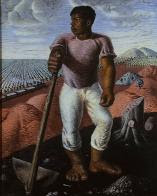
Cândido Portinari -------The farmer of coffee (1934)
Cândido Portinari(December 29, 1903 - February 6, 1962) was one of the most important Brazilian painters and also a prominent and influential practitioner of the neo-realism style in painting.
Born of Italian immigrants in a coffee plantation near Brodowski, in São Paulo Portinari studied at the Escola Nacional de Belas Artes (ENBA) in Rio de Janeiro. In 1928 he won a gold medal at the ENBA and a trip to Paris where he stayed until 1930, when he returned to Brazil.
He joined the Brazilian Communist Party and stood for senator in 1947 but had to flee Brazil for Uruguay due to the persecution of Communists. He returned to Brazil in 1951 but suffered ill health during the last decade of his life and died in 1962 due to lead poisoning from his paints.
They include images of childhood, paintings depicting rural and urban labour, refugees fleeing the hardships of Brazil's rural north-east, treatments of the key events in the history of Brazil since the arrival of the Portuguese in 1500, portraits of members of his family and leading Brazilian intellectuals, illustrations for books, tiles decorating the Church of São Francisco at Pampulha, Belo Horizonte. There were a number of commemorative events in the centenary of his birth in 2003, including an exhibition of his work in London.
Cândido Portinari -------O lavrador de café (1934)
Cândido Portinari (29 de dezembro de 1903 - 6 de fevereiro de 1962) foi um dos mais importantes pintores brasileiros, e também um proeminente e influente praticante do estilo neo-realismo na pintura.
Nascido de imigrantes italianos, em uma plantação de café próxima a Brodowski ,em São Paulo, Portinari estudou na Escola Nacional de Belas Artes (ENBA), no Rio de Janeiro. Em 1928, ele ganhou uma medalha de ouro na ENBA e uma viagem a Paris, onde ele permaneceu até 1930, quando ele retornou ao Brasil.
Ele aderiu ao Partido Comunista Brasileiro e permaneceu como senador. Em 1947, teve de fugir para o Uruguai devido à perseguição dos comunistas. Ele voltou ao Brasil em 1951, mas sofreu problemas de saúde durante a última década de sua vida e morreu em 1962 devido a envenenamento de chumbo por causa de suas pinturas.
Essas incluem imagens de infância, pinturas ilustrando o trabalho rural e urbano, os refugiados que fogem da miséria do Brasil rural do nordeste, tratamentos dos principais eventos da história do Brasil desde a chegada do Português, em 1500, retratos de membros da sua família e líderes intelectuais brasileiros, ilustrações para livros, e ladrilhos que enfeitam a Igreja de São Francisco em Pampulha, Belo Horizonte. Houve uma série de eventos comemorativos do centenário do seu nascimento em 2003, incluindo uma exposição do seu trabalho em Londres.


